The Simple Proof of Fermat’s Last Theorem
By
Terrence Mummert
Correpondence: terry@mathpossibilities.com
Fermat’s Last Theorem states: There are no three positive integers A, B, and C satisfy the equation An + Bn = Cn for any integer value of n greater than 2.
ABSTRACT
Fermat’s assertion that Cn≠An+Bn is proven by the application of Pascal’s Triangle.
Fermat’s Last Theorem (FLT) is proven by examining the coefficients resulting from (A+B)n-An or (A+B)n-Bn. Apply the principles of Pascal’s Triangle, where the sum of the coefficients from (A+B)n must equal 2n. When (A+B)n-An or (A+B)n-Bn, the sum of the resulting coefficients is 2n-1. This is the proof that Fermat was correct in his assertion.
_________________________________________________________________________
Fermat’s Last Theorem (FLT) can be proven using coefficients resulting from (A+B)n, and then apply the principals of Pascal’s Triangle where the sum of coefficients must equal 2n. Through the examination of the coefficients of binomial fragments resulting in (A+B)n-An=Bn or (A+B)n-Bn=An and applying the defined in properties of Pascal’s triangle to that fragment, it is proof that Fermat was correct in his assertion. The sum of the coefficients from (A+B)n-An=x, or (A+B)n-Bn=y, x and y can be proven to always have 2n-1 as the sum of the coefficients.
Pascal’s triangle demonstrates the sum of the binomial coefficients of any (A+B)n will always be a member of the set {2n}. When An or Bn, each with a coefficient of 1, is subtracted from the resulting expansion of (A+B)n, the resulting difference of the coefficients will equal {2}n-1 and no longer a member of Pascal’s assertion. The sum of the coefficients of this fragment is now always an odd numbers and can never be a member of {2n}.
Fermat is proven correct in his theory.
Key Words: 1; Fermat; 2, FLT; 3, Pascal
_________________________________________________________________________
Introduction
This paper shows the proof of Fermat’s Last Theorem in math principals which existed during Fermat’s time. It would have been a great loss to human understanding of theoretical math had this proof been earlier known, as FLT has driven many great leaps in mathematics. Yet, the simple proof does exist, exactly as Fermat said it would.
Fermat and Pascal
To truly appreciate this proof of FLT, the history of Pierre de Fermat (1607-1665) and Blaise Pascal (1623-1662) should be known. They were mathematicians living in France in the same time. It is well known they correspond and met. In a series of letters[1] between the two from 1650 to 1654, their work together resulted in the Probability Theory.
It should be no surprise that Fermat would have intimate knowledge of Pascal’s other works as Pascal sought Fermat’s council in other matters. This would have included Pascal’s works on coefficients, found in the Treatise on the Arithmetical It should be no surprise that Fermat would have intimate knowledge of Pascal’s other works as Pascal sought Fermat’s council in other matters. This would have included Pascal’s works on coefficients, found in the Treatise on the Arithmetical [2], resulting in what we now call Pascal’s Triangle. I believe it probable that FTL was a spinoff from this work.
Chasing A & B
The historical approach to FTL has only been through the manipulation of A and B. Andrew Wiles finally succeeded with this in 1996 and opened a whole new universe of theoretical math. For that reason, Fermat’s Last Theorem has been a landmark in mathematics. The energy spent in the pursuit of FLT’s proof has launched great learning.
I suspect Fermat has been amused for almost 400+ years. Fermat perhaps expected Pascal to also chase A and B down the rabbit hole. Why not? Mathematicians have done so as it is the most obvious approach. This is the approach theories and attempts at proofs available to me have used. The acknowledged proof offered by Sir Andrew Wiles used this approach. All the while, the proof of FLT lies in Pascal’s works. It is the coefficients and their properties which are the simple proof to FLT.
- Fermat said his proof was simple.
- The mathematics for this proof existed in Fermat’s days.
To prove this paper wrong would require the two proofs of Pascal’s triangle to also be proven wrong[3].
Exploring binomials where C=A+B
There are basic truths which will be built on. For
any given positive variable greater than 1, there exists two positive numbers
which can be added together an equal that variable. The larger the number, the
more combinations. Or better known as order pair.
Consider the variable C where
C=A+B. There follows C2=(A+B)2, C3=(A+B)3,
C4=(A+B)4, Cn=(A+B)n.
Next consider the resulting binomial formula which
results from the expansion of (A+B)n as traditionally written: C3=(A+B)3 , C4=(A+B)4,
Cn=(A+B)n.
(A+B)3= A3+3A2B+3AB2+B3
(A+B)4=A4+4A3B+6A2B2+4AB3+B4
(A+B)n= An+
[Calculated] +Bn
The obvious path
When looking at the binomial expansion of (A+B)n
as demonstrated above, it lends to the desire to deal with the values of A and
B when defining any further functions. This has been the historic path. But
there is a less obvious representation which needs to be examined:
Cn=(A+B)n,
for example:
· n=3: (A+B)3= 1A3+3A2B+3AB2+1B3
· n=4: (A+B)4=1A4+4A3B+6A2B2+4AB3+1B4
· n=∞: An+[Calculated] +Bn
The coefficient for An and Bn is 1. 1 is most often not stated in an equation. It is just implied.
For Fermat, the 1 must be stated.
Recognition where 1An and 1Bn have a coefficient of 1 is key to relating FLT to Pascal’s Triangle. It is through the examination of the coefficients that Pascal proves FLT.
(A+B)3= 1A3+3A2B+3AB2+1B3, the coefficients total to 8, 23.
(A+B)4= 1A4+4A3B+6B2B2+4AB3+1B4, the coefficients total to 16, 24.
(A+B)∞= 1A∞+ [Calculated] +1Bn, the coefficients total to 2∞.
1An and 1Bn are constants for every (A+B)n. Identifying the constants is key to any proof.
Pascal asserted “The sum of the coefficients in the nth row of Pascal’s triangle is 2n.”
There are two published proofs confirming this to be true to this assertion. The coefficients for Pascal’s Triangle are derived from (A+B)n. This represents every Cn when C=(A+B). In the case for n=6, any two integers can be fed into the formula for A and B.
C6=(A+B)n=1A6+6B5B+15A4B2+20A3B3+15A2B4+6AB5+1B6 and the results will be every value {C6}.
Pascal’s triangle evaluates the sum of coefficients of every Cn for Cn=(A+B)n to always be 2n.
Pascal’s triangle demonstrates, when reading across any row for n, the coefficients will always sum to a value of 2n. The bottom row in the below illustration represents the coefficients for the binomial, (A+B)5. The sum of these is 32 or 25. And when vertically, the constant of 1 is present on both the An and the Bn side.
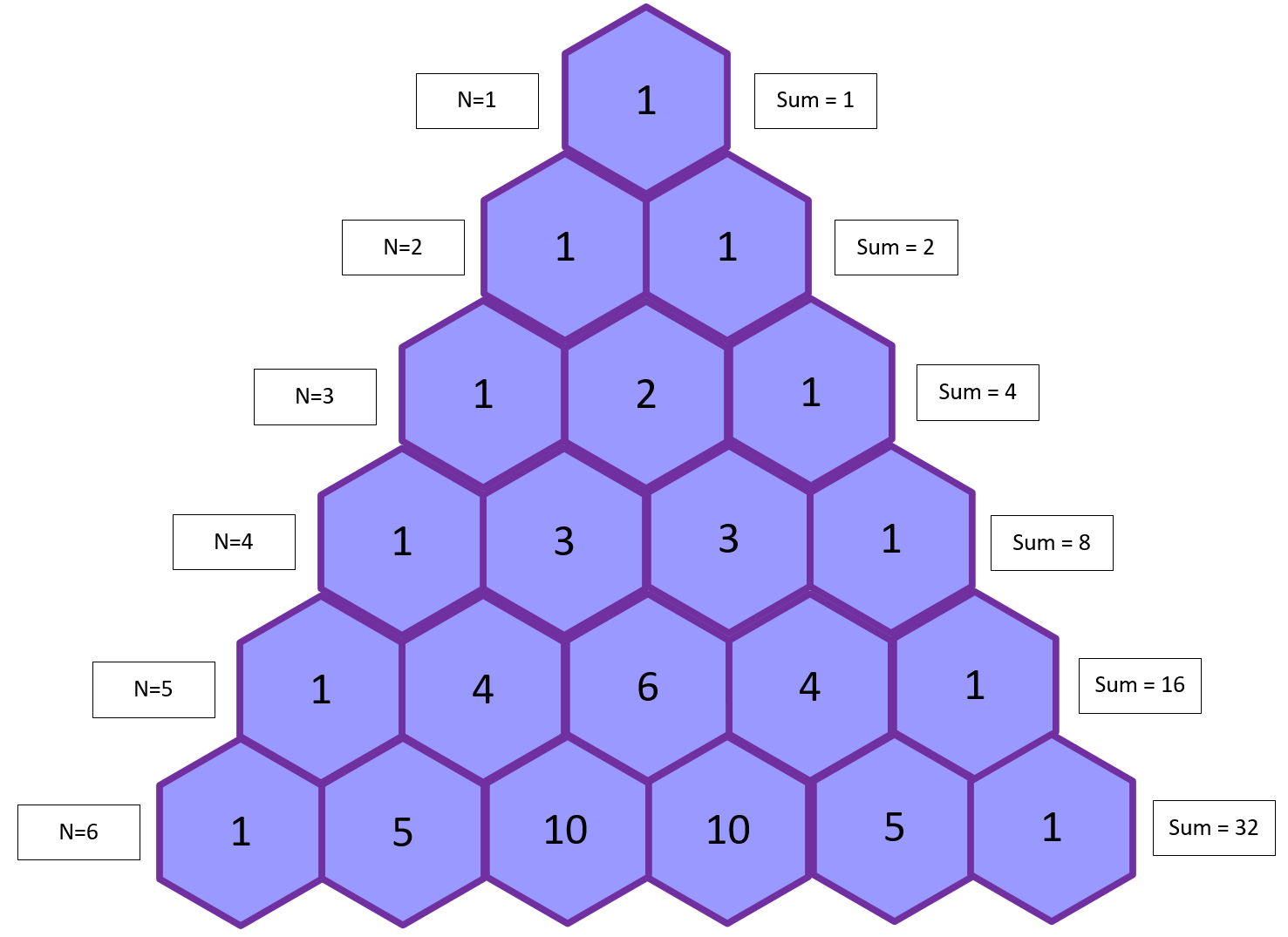
n depicts the expansion of (A+B)n when n=6 and the extraction of the coefficients. It must also be noted the constants 1An and 1Bn have the same coefficient, 1, for all values of n. This provides both horizontal and vertical constants for which makes the evaluation of Pascal’s Triangle apply easily to Fermat.
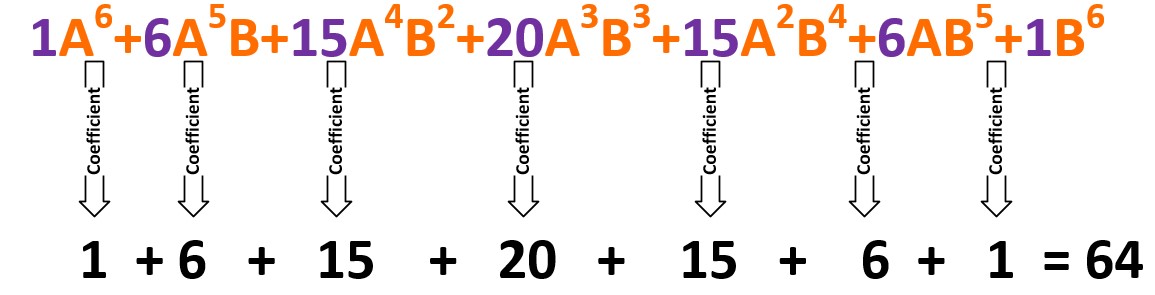
For n=6, {1, 6, 15, 20, 15, 6 and 1} are the coefficients for (A+B)6.
Cn=(A+B)n. Below example demonstrates (A+B)n=6 when Fermat is (A+B)n-An=Bn.
Consider (A+B)n-An=Bn when (A+B)n=1A6+6A5B+15A4B2+20A3B3+15A2B4+6AB5+1B6. This is a true statement and will be true for every value of A and B. Now evaluate the coefficients from the resulting fragment on the right side of the equals sign when 1A6 is subtracted. 6A5B+15A4B2+20A3B3+15A2B4+6AB5+1B6. The coefficients are {6 + 15 + 20 + 15 + 6 + 1}, sum to 63, are an odd number and can never be a member of {2n}. This fragment does not pass Pascal’s test to be a member of { i n}.
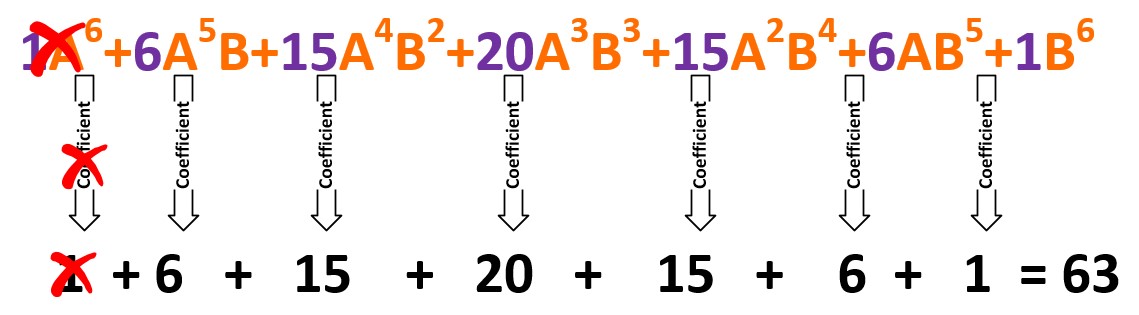
6 + 15 + 20 + 15 + 6 + 1 = 63, 63≠26
Above are the coefficients after 1B6 is subtracted from the expansion of (A+B)6.
Pascal proves C6-A6=B6 can not exist.
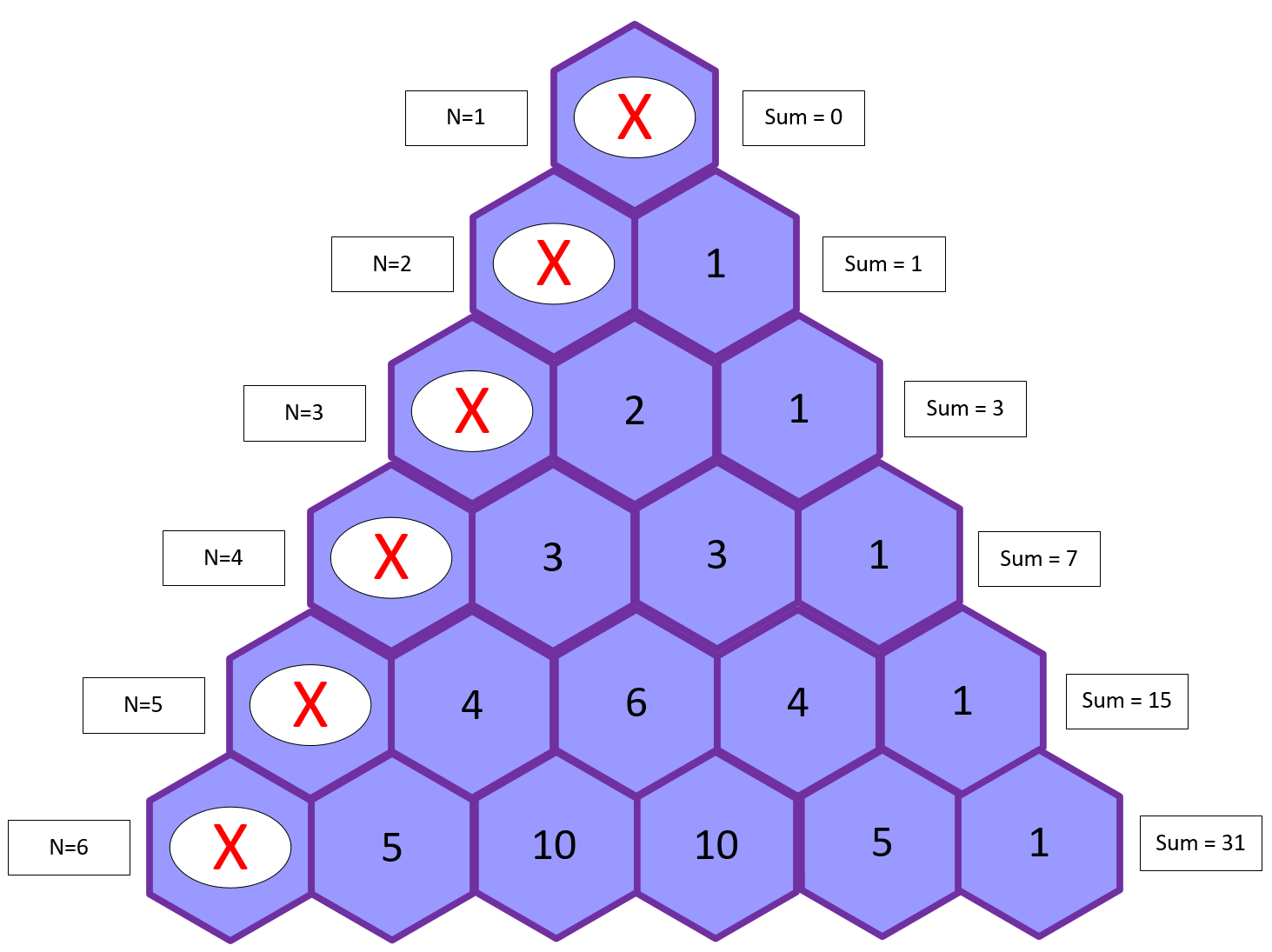
Cn=(A+B)n. Below example demonstrates this reciprocal equation for (A+B)n=6. Consider
Consider (A+B)n-Bn=An when (A+B)n=1A6+6A5B+15A4B2+20A3B3+15A2B4+6AB5+1B6. This is a true statement and will be true for every value of A and B. Now evaluate the coefficients from the resulting fragment on the right side of the equals sign when 1B6 is subtracted. 1B6+16A5B+15A4B2+20A3B3+15A2B4+6AB5. The coefficients are {1+6 + 15 + 20 + 15 + 6}, sum to 63, are an odd number and can never be a member of {2n}. This fragment does not pass Pascal’s test to be a member of { i n}.
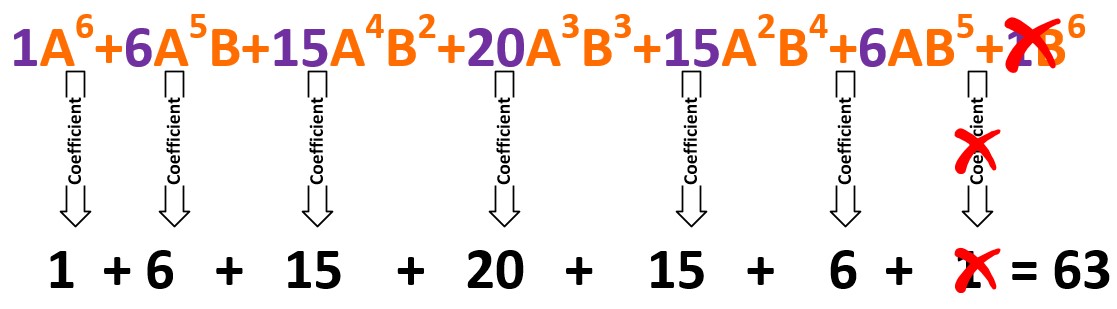
Above are the coefficients after 1A6 is subtracted from the expansion of (A+B)6.
Pascal proves C6-B6=A6 can not exist. 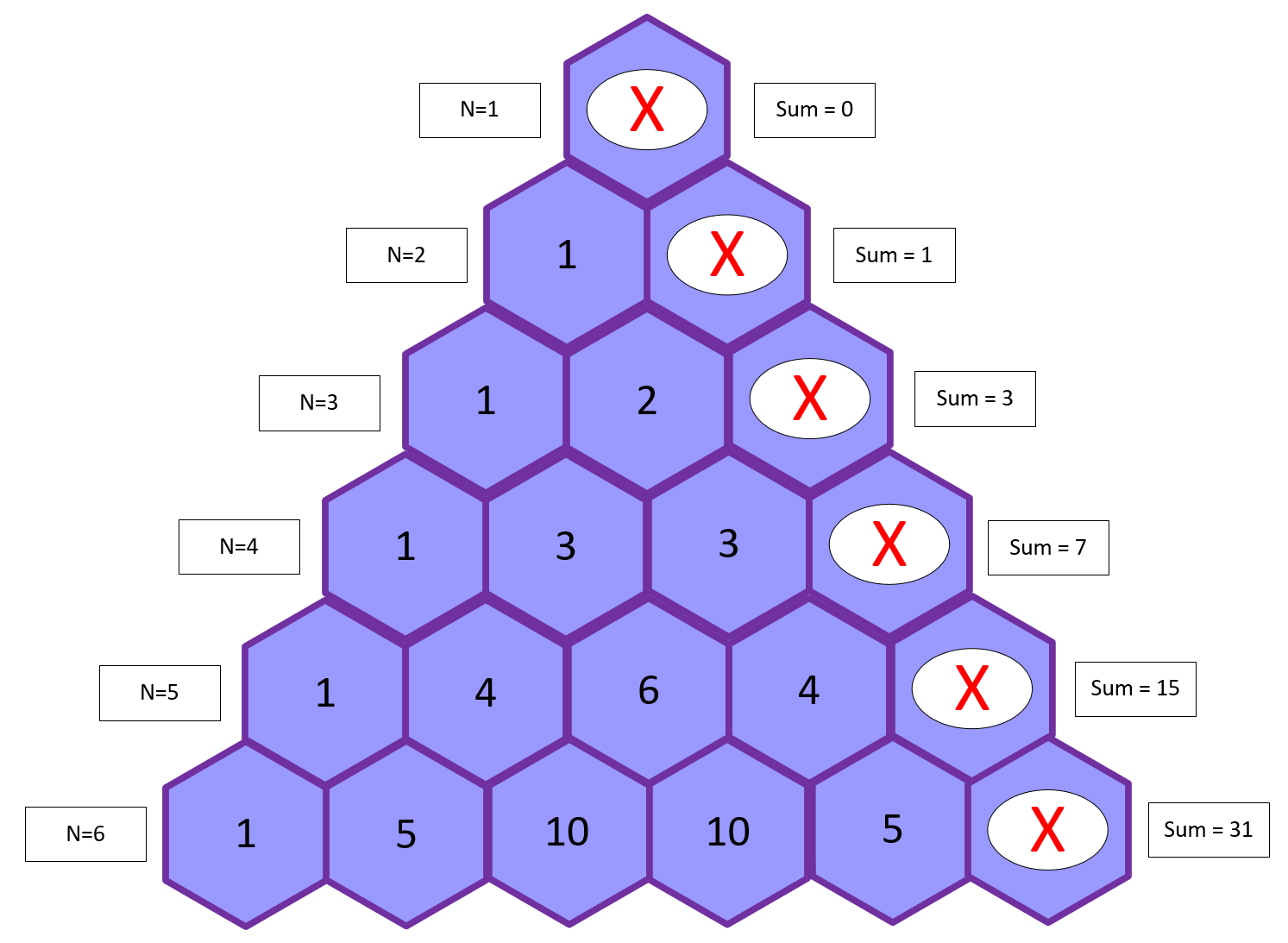
The Proof Is In The the Coefficients
It is not the pursuit of the values of (A+B)n as used in Andrew Wiles proof and in all other attempts I could find. Rather, the proof is simply found in by applying the rules of Pascal to the coefficients of (A+B)n. The sum of the coefficients of any (A+B)n must equal 2n. For the sum of the coefficients of Cn-An or Cn-Bn to be member of {in}, the sum of the coefficients of the fragments for Cn-An or Cn-Bn must sum to 2n. An or Bn, when subtracted from Cn, each have a coefficient of 1 leaving the coefficient of the resulting fragment a value an odd number and short of meeting Pascal’s requirement of {in} by 1.
- https://www.york.ac.uk/depts/maths/histstat/pascal.pdf. All but the last two letters, from which the Theory of Probability is found, were translated from the French by Professor Vera Sanford, Western Reserve University, Cleveland, Ohio, and appear in A Source Book in Mathematics (ed. D E Smith). The last two were translated by Maxine Merrington and appear in Games, Gods and Gambling by F N David.↑
- Blaise Pascal’s Treatise on Arithmetical Triangle was written in 1653 and appeared posthumously in 1665. ↑
- Two proof exist for Pascal’s Triangle can be found at Canada/USA Mathcamp site: https://www.mathcamp.org/files/yearly/2017/quiz/pascal.pdf. ↑