Binary Masking principles:
Masking: The process of looking at a defined segment of a binary word as identified by any two points within a word.
Example for 815:
In the below example, binary word 815 is broken into two parts:
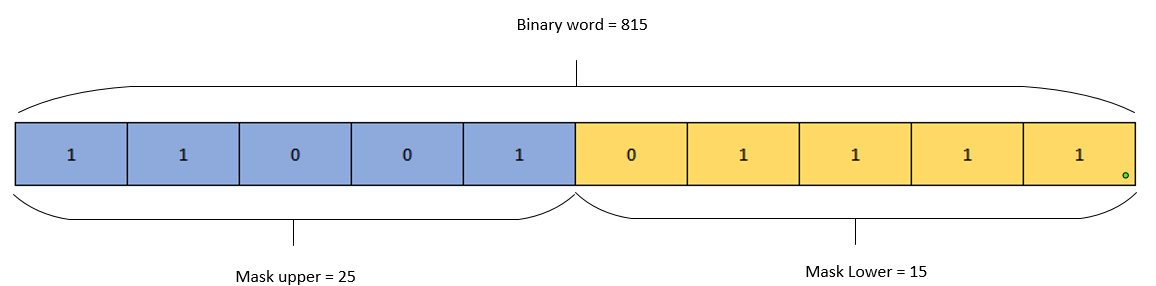
Mask value: From a binary starting bit 20 and all bits senior through 24, the masked value is 15.
Mask value: From a binary starting point of 25 and all bits senior within the mask, the value is 25.
Masking provides a way to see the inside workings of any binary word. Specific to Collatz, masking will show how one masked value can be contained as a part within a larger word.
Masking is used heavily throughout this proof. It is a key concept to binary and how to read a binary work.
Other examples from the above binary word = 815

The upper 2 bits of 815 masked = 112 = 3

The upper 4 bits of 815 masked = 11002 = 12

The last 3 bits of 815 masked = 1112 7

- The center 4 bit of 815 masked = 01012 = 5
- Masking is specific to the bits selected and the needs of the selection. The reasons for specific masks will be apparent in this proof.
Most often, the masks used in this proof of Collatz Conjecture will identify the mantissa and the characteristic of the binary value an put the values into a binary floating-point representation.