Collatz and 4x+1 (Seed 1)
The Rule of 4x+1: Any number x, when multiplied by 4 and 1 is added, the results will behave in Collatz the same as the original x.
Collatz and 4x+1 (Seed 1)
The set {1, 5, 21, 85, 341, 1365, 5461, 21845, 87381…} have long been known as the last stop in the Collatz Conjecture before it resolves to 1. This set can be built by starting with 1, then multiply by 4x+1. Repeating 4x+1 will result in the above set. Examine the below expansion of 4x+1 when x1=1.
x=1, 4x+1: 1*4+1=5
x=5, 4x+1: 5*4+1=21
x=21, 4x+1: 21*4+1=85
x=85, 4x+1: 85*4+1=341
x=341, 4x+1: 1365*4+1=1365
x=1365, 4x+1: 1365*4+1=21485
x=21485, 4x+1: 1365*4+1=87381
Now see them in Binary

The list goes continues to infinity. As an example, examine 87381which will be used to define this part of the Collatz enigma.
Examine 4x+1 by using 1x+2x=3x. Now, apply the rule of 1x+2x=3x. (See the link 1x+2x=3x for explanation)

The evaluation of 87381 provides answers as to why Collatz works as it does. By viewing the Collatz iteration of 87381 in binary, look at the symbiotic relationship of 1x and 2x and how, when added, result in 3x. And, the 3x value will always be a value of 2n-1. Therefore, adding 1 will result in 2n, or the final solution. When using steps, this causes repeating divide-by-2 steps to arrive at 1 in the Collatz Process and 1 x 218 for the Collatz Equation.
It is easy to see exactly why 87381 falls to 1 in a Collatz Process iteration. In binary the pattern of alternating 1’s and 0’s results in 1x is stacked over 2x. Their sum will result in an all 1’s value. Adding 1 to this results in a 1 will result in 2n. In the case for 87381, the final results is 1 x 218 for the Collatz Equation.
Collatz and 4x+1 (Seed {i})
Above, the 4x+1 was seeded with 1. Consider seeding with another integer. Below is an example of the 4x+1 effect for a seed of 59.

It can be identified that 972177 has a root operand of 59. Now apply the 1x+2x=3x rule to 972177and it can be easily seen it falls to the same Collatz Process as 59, 177. Yet, the true value of the Collatz Equation result in Collatz Equation is 2916352 or 177 x 215.

The above has a special consideration for the results of 177. 177 can be identified as 11×4+1. So the operand going into the next Collatz Process is 177, but acts like 11.
Any number, 4x+1 will always fall the same as the original x. This explains the Collatz Process of repeated divide-by-2s and how numbers have distinctive branches when mapped in a table.
Collatz and the Even Operand
This is just a side note as the Collatz Conjecture does not allow even numbers to process through the 3x+1 without first dividing by 2 until the number becomes odd. But the 4x+1 must also consider even integers. Consider the value 233. 233 can be represented as 58*4+1.
It is interesting where 233 and 58 (if not processed by a divide by 2 first) both result in 175 if processed through the 3x+1 and divide by 2’s. 58*3+1=175
233*3+1=700, 700÷2=350, 350÷2=175.
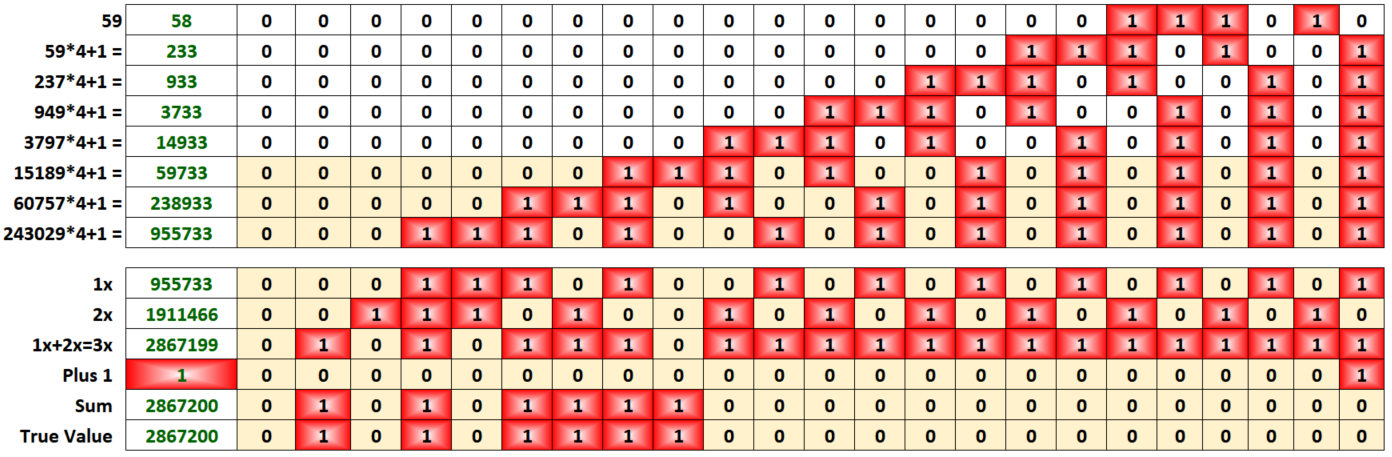
So, it can be shown, in the 4x+1 world, even base numbers can exist.
Just a fun fact for 4x+1.